What is Social Jetlag?
Sleeping In on Weekends = The Culprit Behind Monday Fatigue
It sounds counterintuitive, doesn’t it?
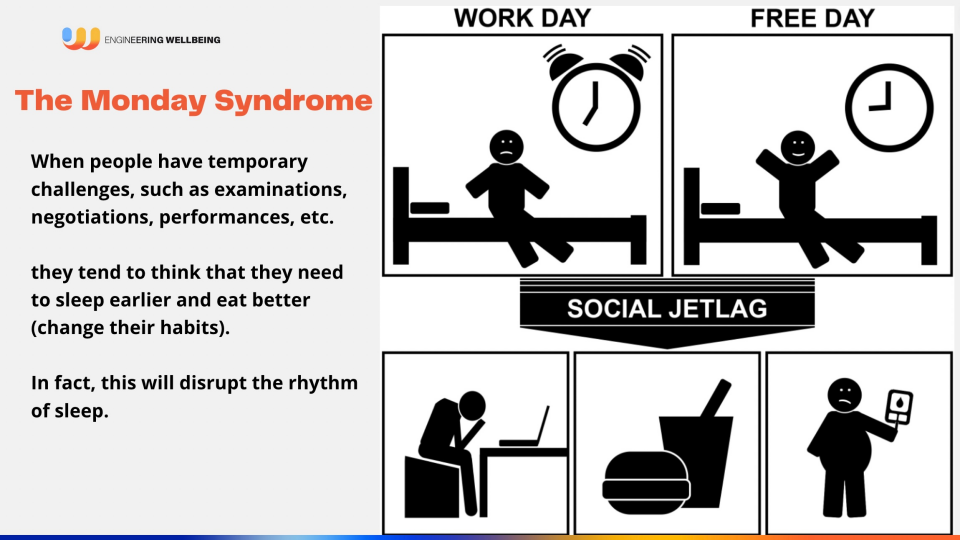
We often assume weekend catch-up sleep pays off our “sleep debt,” but in reality, you are “creating new jetlag.”
Picture this:
On Friday night, you “fly” to a western time zone (staying up late and waking late).
On Monday morning, you are instantly “teleported” back to the eastern time zone (having to wake early for work or school).
Your body gets virtually no time to adapt to this “cross-time-zone travel”.
Consequence: you spend your entire Monday “recovering from jetlag-like symptoms”.
The Scientific Evidence
Social jetlag is not a vague concept, but a physiological phenomenon backed by solid scientific research.
Key findings:
- Social jetlag correlates with poorer academic and work performances
- It is strongly linked to mood swings
- Long-term social jetlag may exert negative effects on metabolic and immune function
- People of different chronotypes vary in how severely they are affected by social jetlag
What Is a Chronotype?
Everyone’s biological clock has its own preferred rhythm.
- Morning Type: Naturally prefers going to bed early and waking up early
- Evening Type: Naturally prefers going to bed late and waking up late
- Intermediate Type: Falls somewhere in-between
The Impact of Social Jetlag
- Heightened fatigue on Monday mornings
- Impaired daytime concentration and productivity
- In the long term, it is correlated with mood swings and decreased academic or work performance
- Potential negative effects on physiological systems such as metabolism and immunity
How to Minimize Social Jetlag?
The problem is: modern work and school timetables are largely built for morning types. Evening-type individuals therefore face greater circadian pressure on workdays and are far more likely to experience severe social jetlag on weekends.
- Keep a regular wake-up time. Try to wake up at the same time every day, including weekends.
- Limit weekend catch-up sleep to no more than 1 hour. If you are really tired, go to bed earlier rather than waking up later.
- Get natural sunlight in the morning. Sunlight is the most powerful signal for regulating your biological clock.
- Establish consistent morning and evening routines. Let your body know when to wake up and when to sleep.
Final Words
Sleep is not a bank account where you can “deposit” and “withdraw.”
Truly high-quality sleep comes from consistency, not duration.
Instead of struggling to wake up every Monday, start today by giving your biological clock a more stable rhythm.
Your body deserves gentle, consistent care.
Source: Wittmann M, Dinich J, Merrow M, Roenneberg T. Social jetlag: misalignment of biological and social time. Chronobiol Int. 2006;23(1-2):497-509.